
Introduction
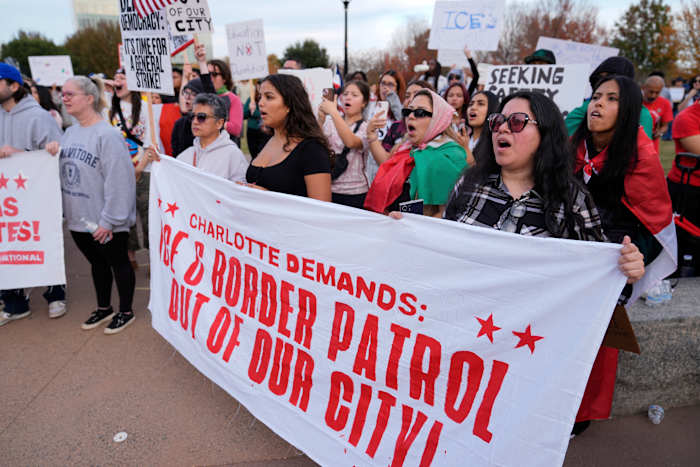
This article drew significant public attention and concern after a recent surge of federal immigration enforcement in Charlotte, North Carolina. Many local residents and city officials voiced frustration and alarm, especially as fears spread regarding the scope and intent of the federal operations. One key question became whether Charlotte’s mayor had given approval for the heightened Immigration and Customs Enforcement (ICE) activity—prompting an in-depth analysis of the claims and context presented in the news coverage.

Historical Context
Charlotte has a longstanding reputation as a diverse, rapidly growing city in the American South. In recent years, debates over “sanctuary policies,” federal-state cooperation, and local authority around immigration enforcement have become central flashpoints nationwide. The Trump administration’s approach has focused on aggressive immigration enforcement and criticized sanctuary jurisdictions for declining to cooperate with federal detainers. The most recent operation in Charlotte came amid tensions over public safety, civil rights, and the broader national immigration debate—making local leaders’ responses especially meaningful to residents and observers alike.

Fact-Check of Specific Claims
Claim #1: Has the mayor of Charlotte approved the ICE activity to remove illegal aliens from her city?
The mayor of Charlotte, Vi Lyles, has not approved the recent ICE operations in her city. In fact, Mayor Lyles has publicly opposed the federal enforcement surge, expressing concern that it “is causing unnecessary fear and uncertainty” among Charlotte’s residents. Local officials have repeatedly emphasized that city leadership was not notified in advance, nor did they participate in, endorse, or support these operations. The Charlotte-Mecklenburg Police Department also clarified that it does not assist with or authorize such federal immigration activity. This directly addresses user questions and concerns, and it is supported by public statements and news coverage (AP News, WBTV).
Claim #2: The Trump administration targeted Charlotte for immigration enforcement despite downtrending crime rates and local objections.
This claim is accurate. The recent enforcement operation—labelled by some as a “surge”—was carried out in Charlotte, a city with a population near 950,000 and known for Democratic leadership and “sanctuary” practices. The Charlotte-Mecklenburg Police Department’s public safety statistics confirm an 8% decrease in overall crime and a 25% reduction in violent crime in 2025 compared with 2024. Meanwhile, city leaders and community advocates have issued “fierce objections” to the federal initiative, highlighting both safety statistics and the destabilizing effect on immigrant families (charlottenc.gov, AP News).

Claim #3: Charlotte residents reported encounters with Border Patrol agents at churches, apartment complexes, and stores.
This claim is supported by multiple verified reports. Residents in Charlotte’s immigrant-heavy neighborhoods confirmed that U.S. Customs and Border Protection agents operated not only in public spaces, but also near churches and busy retail areas, contributing to widespread concern. Reports from local outlets describe visible federal presence, business closures, and disruptions in daily routines as families avoided leaving home due to fear of detainment (WFAE).
Claim #4: DHS alleged that about 1,400 detainers across North Carolina had not been honored, putting the public at risk.
The article accurately relays concerns expressed by the Department of Homeland Security regarding immigration detainers. DHS maintains that approximately 1,400 immigration detainers were not honored by local agencies in North Carolina, which department officials argue undermines public safety. While the actual risk to the public is debated by local leaders, the factual basis for the number and the DHS assessment is confirmed by recent federal statements and reporting (Reuters).
Conclusion
The news article provides an accurate account of the facts around the recent federal immigration enforcement surge in Charlotte. Key claims—such as the city’s crime rate decline, the level of local opposition, the scope of agent activities in neighborhoods, and DHS’s detainer allegations—are substantiated by police statistics, community reporting, and official statements. Importantly, the article does not falsely suggest that Mayor Vi Lyles or city leadership approved the ICE actions; in fact, the mayor’s opposition and statements are consistent with coverage from multiple independent outlets. No significant distortions, misinformation, or bias were identified in the main reporting, though the article does focus considerably on voices critical of the federal operation—a reflection of prevailing sentiment among city officials and community groups.