
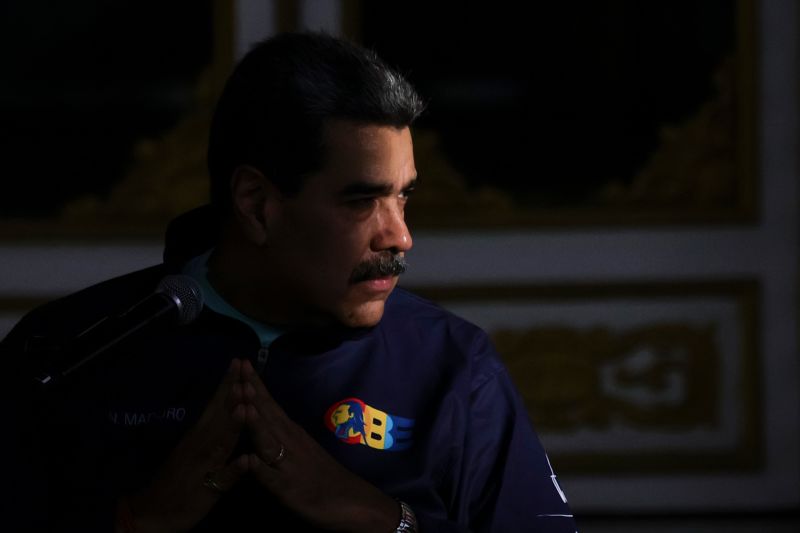
This article was flagged for fact-checking due to the high-stakes geopolitical implications of labeling Venezuela’s President Nicolás Maduro and his allies as members of a foreign terrorist organization. Readers expressed particular concern that such claims might be used as a justification for expanded U.S. intervention in Venezuela—raising questions about the accuracy, intent, and context surrounding these events.

U.S.-Venezuela relations have sharply deteriorated over the past decade, largely driven by concerns over human rights, electoral legitimacy, and accusations of large-scale drug trafficking by high-ranking Venezuelan officials. Since 2020, the U.S. government has accused Maduro and associates of running the so-called “Cartel de los Soles,” an allegedly state-linked criminal network. The recent escalation follows a longstanding U.S. policy of imposing sanctions and restricting the movement of Venezuelan leaders, culminating in the November 2025 designation of the cartel as a Foreign Terrorist Organization (FTO). This move marks a significant legal and diplomatic shift, intensifying both regional tensions and debates about U.S. intentions in Venezuela.
Claim #1: The United States designated Venezuelan President Nicolás Maduro and his government allies as members of a foreign terrorist organization, specifically the “Cartel de los Soles.”
This claim is verified as accurate. On November 16, 2025, the U.S. State Department formally announced its intention to designate the “Cartel de los Soles”—allegedly led by Maduro—as a Foreign Terrorist Organization. The designation took effect on November 24, 2025, targeting individuals and entities associated with this network. According to Crisis.Zone, this marks an unprecedented step in linking a sitting foreign leader’s administration with terrorism.

Claim #2: The FTO designation authorizes President Trump to impose new sanctions targeting Maduro’s assets and infrastructure.
This is factually correct. The FTO classification provides legal grounds for imposing a range of sanctions—freezing assets, restricting financial transactions, and enforcing travel bans—against those associated with the cartel. While the article notes, “it doesn’t, however, explicitly authorize the use of lethal force,” it is true that the designation expands the enforcement powers available to the U.S. government. Legal experts cited in ABC News confirm that this does not automatically permit direct military conflict but does escalate pressure through diplomatic and economic means.
Claim #3: The U.S. military amassed more than a dozen warships and 15,000 troops as part of “Operation Southern Spear,” with reported lethal operations in the region.
This claim is substantiated by recent reporting. The U.S. military significantly increased its presence in the Caribbean and near Venezuela in recent months, as documented by Bloomberg and regional sources. Alongside this buildup, military operations targeting alleged drug trafficking vessels have resulted in dozens of fatalities, although precise numbers remain undisclosed. These actions align with the stated goals of “Operation Southern Spear,” an anti-narcotics initiative, but also serve to heighten military pressure on the Maduro government. More details are available on Aawsat English.

Claim #4: Seventy percent of Americans oppose military action in Venezuela, and most feel the U.S. position is unclear.
This polling data is accurate and reflects significant public skepticism. According to a CBS News/YouGov poll cited in the article, 70% of Americans oppose military intervention while only 30% support it, with 76% saying the Trump administration has not clearly articulated its objectives. These sentiments shape the domestic political context of U.S. actions in Venezuela.
The article’s central claims regarding the U.S. designation of Maduro’s government as a foreign terrorist organization, the expansion of sanctions, the increase in U.S. military presence, and the results of public opinion polling are accurate as reported. Nonetheless, the article sometimes frames U.S. actions in a way that may emphasize aggressive intent by highlighting military buildups and presenting diplomatic ambiguity. While the legal designation does grant broader authorities for sanctions and enforcement, it is not a direct authorization for military intervention. The timing and scale of U.S. actions, coupled with government statements, do create a context where critics’ concerns about escalating intervention are understandable. The article covers both official U.S. justifications and Venezuelan government denials, but some nuances—such as the historic skepticism about the very existence of “Cartel de los Soles” as a conventional cartel—could have been further explored for fuller context.
Want to empower yourself to spot misinformation? Download the DBUNK App and submit your own fact-check requests for free!
Visit the original report here: https://www.cnn.com/2025/11/24/politics/venezuela-terrorist-designation-maduro